Session Summary
How to fight scope creep when work never stops: 5 boundary rules for tech professionals
La French Tech’s Thriving in Motion February meetup brought together tech professionals for an energizing evening of conversation, networking, and practical insights on staying balanced in high-pressure careers. Featuring Juliette Fiszka (founder of Good in Motion) and Mareike (science-based fitness and nutrition coach), the session explored two challenges that often show up together when work moves fast: scope creep that quietly extends the workday, and stress patterns that undermine performance, energy, and health goals. From boundary-setting strategies to evidence-based approaches for sustainable wellness, the event delivered actionable takeaways designed to help ambitious people work with more intention—without burning out.
As part of La French Tech’s recent networking event, Juliette Fiszka, wellness consultant and founder of Good in Motion, addressed a challenge many ambitious professionals know all too well: the feeling that work never truly stops.
In fast-paced tech environments, priorities shift quickly, new requests come up, meetings multiply, and the to-do list rarely seems to get shorter. The result is a constant feeling of being “on,” often followed by guilt at the end of the day, even after working hard for long hours.
In response to this challenge, Juliette introduced her SCOPE Framework, a practical five-step method she developed to help professionals create stronger boundaries without sacrificing performance.
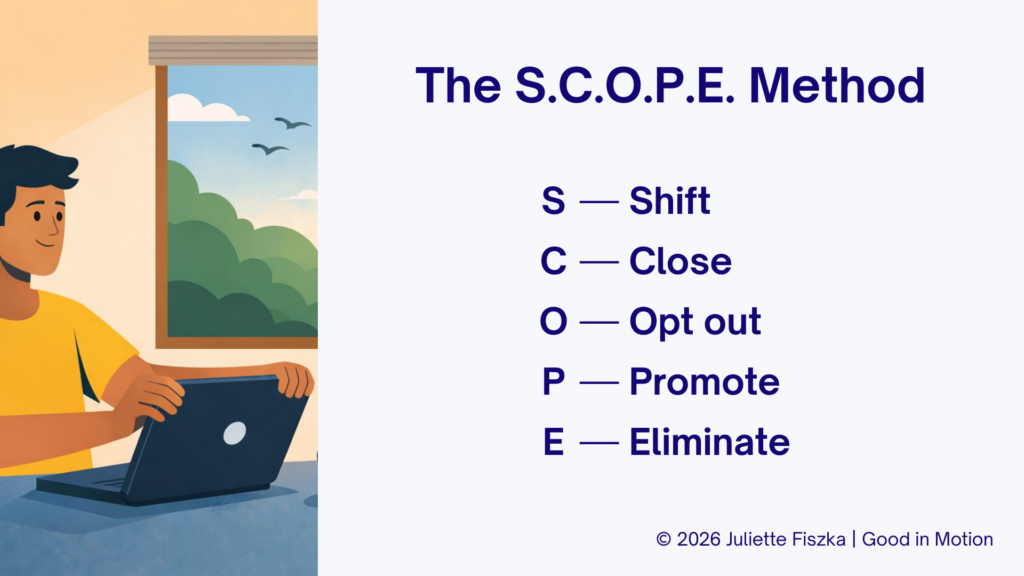
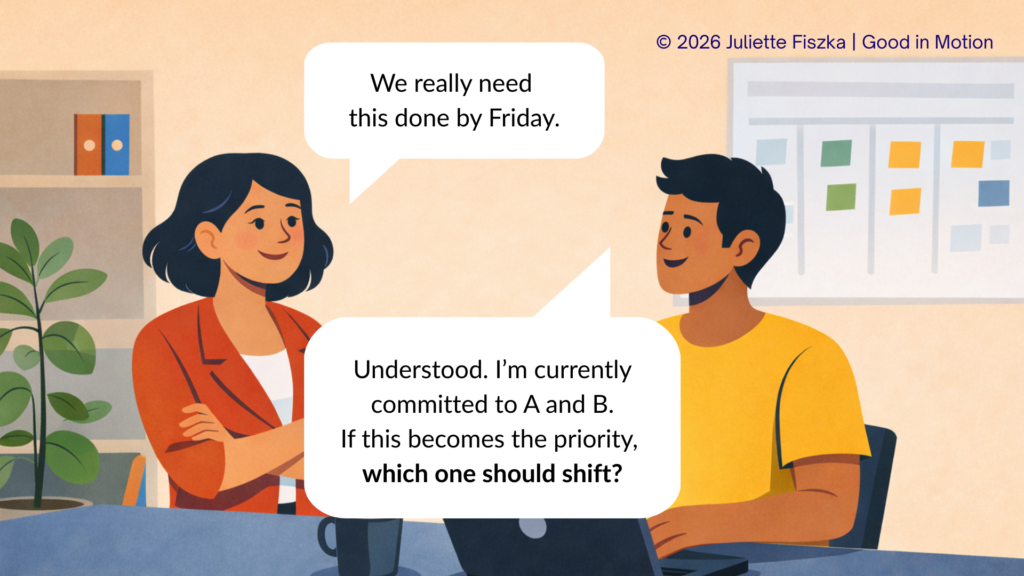
- Shift work instead of stacking it. When new priorities come up, intentionally renegotiate timelines instead of quietly adding extra work to your evenings or personal time.
- Close the laptop on purpose. Create a clear end-of-day ritual by identifying the top three priorities for the next day and then fully disconnecting.
- Opt out of meetings that do not require direct input. Fewer interruptions mean less context-switching and better efficiency throughout the day.
- Promote your work and make it visible. Pause weekly to identify what has been accomplished, then share those updates. This helps you see your progress and allows others to recognize it, especially in long-term work.
- Eliminate what is outside your control. Redirect mental energy toward what is within your control instead of carrying unnecessary stress.
The goal is to replace long, reactive workdays with focused, intentional ones, so that eight productive hours can replace ten exhausting ones, and professionals can close their laptops feeling accomplished instead of behind.
The Q&A sparked thoughtful conversations, with participants sharing their own end-of-day rituals and exchanging practical tips. Many reflected on which of the SCOPE principles they could implement immediately to improve their work-life balance, especially in remote settings where boundaries can be harder to maintain.
Juliette Fiszka is a wellness consultant and founder of Good in Motion. She designs practical systems that help ambitious professionals reduce overwhelm, build stronger boundaries, and create sustainable high performance.
Through talks, workshops, and her signature guided experiences, Juliette helps professionals step off the hamster wheel and redesign how they work and live.

Instagram: https://www.instagram.com/juliettefiszka/
LinkedIn: https://www.linkedin.com/in/juliettefiszka/
Website: https://www.goodinmotion.ca

Mareike is a science-based fitness and nutrition coach specializing in hormones, gut health, and metabolism. She helps high-performing individuals over 30 fix the root causes of stubborn weight gain, fatigue, and bloating so fat loss becomes a sustainable outcome, not a constant battle.
With industry-leading certifications in fitness, nutrition, and hormone health, Mareike translates complex physiology into practical, realistic strategies that fit into demanding careers and full lives. Her approach moves individuals away from restriction and burnout, and toward building resilient, energized bodies that support both performance and long-term health.
Takeaways
Mareike presented on the relationship between stress, metabolism, and sustainable fat loss, particularly for high-performing professionals balancing demanding careers with their health goals. The session explored why many people struggle with consistency and how common fitness myths and chronic stress can interfere with results.
Key Points Covered
• Why “eat less, move more” often backfires
• How Total Daily Energy Expenditure (TDEE) actually works
• The impact of chronic stress and elevated cortisol on fat loss
• How under-eating can act as a physiological stressor
• Why sustainable nutrition habits outperform restrictive diets
The session emphasized a shift away from extreme dieting and toward evidence-based, sustainable practices that support energy, resilience, and long-term body composition changes.